
Key takeaways
- The Maras salt pans hold roughly 4,500 salt wells fed by a natural spring, and sit at about 3,200 metres in Peru's Sacred Valley (UNESCO World Heritage Centre).
- Local families still harvest pink salt by hand using the same evaporation method used since pre-Incan times.
- Visit in the dry season, from May to September, and arrive mid-morning when sunlight brightens the white terraces for photos.
- Maras pairs naturally with the Moray agricultural terraces, and both fit into one relaxed day trip from Chinchero.
The Maras salt mines are a vast cascade of shallow white ponds carved into a hillside in Peru's Sacred Valley, where local families still harvest pink salt by hand. You reach them on a short drive from Chinchero or Cusco, and the best time to arrive is a dry-season morning when sunlight lifts the colors off the terraces. This guide covers the history, how to get there, when to go, and how to pair the salineras de Maras with the nearby Moray ruins.
The salt pans sit at roughly 3,200 metres above sea level, so the air is thin and the sun is strong. A short visit rewards you with one of the most distinctive landscapes in the Andes: thousands of geometric pools stepping down the slope, each one a slightly different shade of white, cream, and rust.
What Are the Maras Salt Mines?
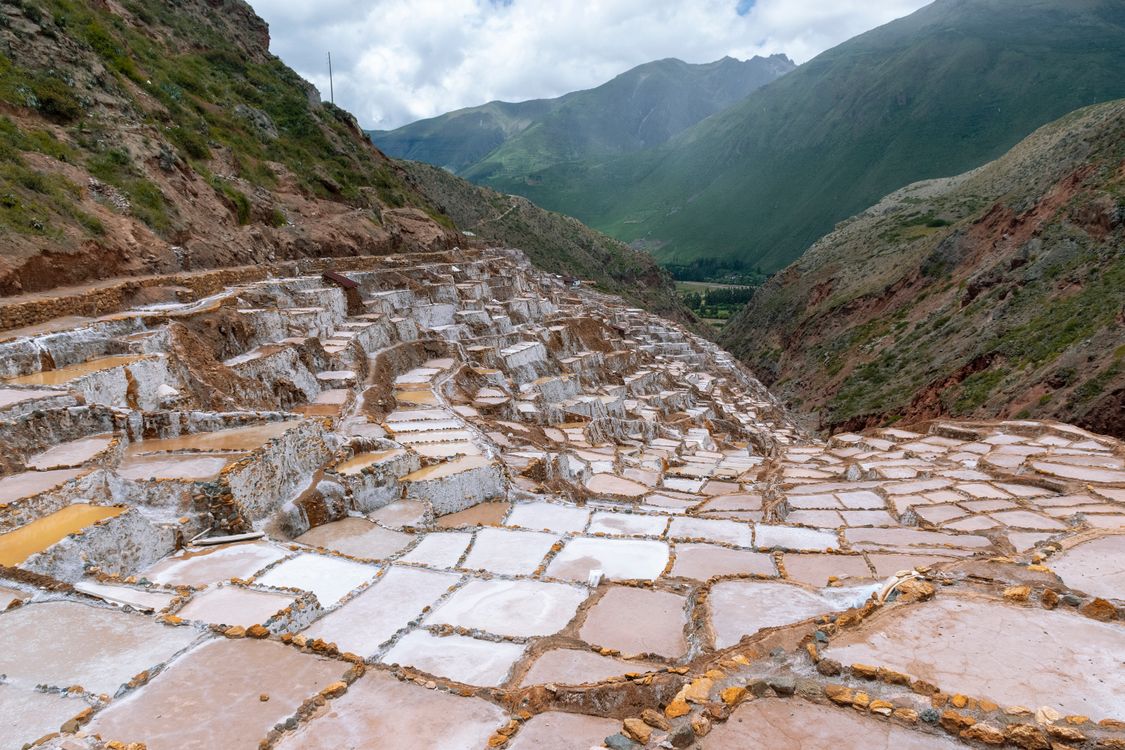
The Maras salt mines are an active salt-harvesting site made up of roughly 4,500 salt wells arranged as stepped terraces on a Sacred Valley hillside (UNESCO World Heritage Centre). A natural spring feeds salty water into hand-built channels, which fill the shallow ponds. As the water evaporates in the mountain sun, salt crystallizes and is scraped out by hand.
The site is also known by its Spanish name, the salineras de Maras. It has been recognized as part of Peru's cultural heritage and has stood on UNESCO's tentative list for World Heritage status since 2019.
What makes the place feel alive, rather than a museum, is that the salt is still worked. Families tend individual ponds, flooding and draining them on a rhythm that has barely changed in centuries.
The History: Pre-Incan Origins
The salt pans predate the Inca Empire. Archaeological evidence points to the Wari culture building the original ponds between roughly 500 and 1100 AD, long before the Inca expanded through the valley. The Inca later inherited and extended the system, and the Spanish recorded it after their arrival.
The water source carries its own history. The spring that feeds the ponds is known in Quechua as Qoripujio, often translated as the "golden spring." It emerges from the mountain already hypersaline, so no salt is added. The mineral content comes entirely from ancient deposits the water passes through underground.
Ownership has stayed local. The ponds are divided among community families, each responsible for their own pools. That communal model, rather than a single company or the state, is a large part of why the harvesting method survived intact.
How the Terraced Pools Produce Pink Salt Today
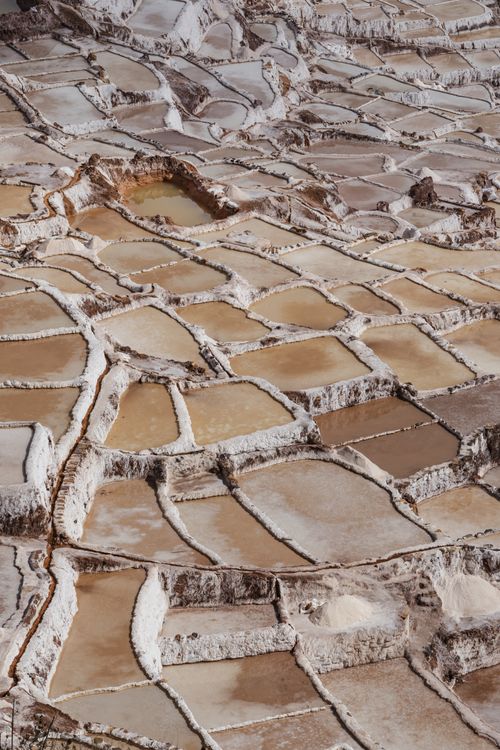
Thousands of terraced pools still produce salt using pure evaporation, with no machinery involved. A worker opens a small channel to flood a pond with spring water, closes it, and lets the sun do the rest over several days. When the water is gone, a crust of salt remains and is raked into mounds to dry further.
The color depends on timing and depth. The first, cleanest crystals are often sold as fine white salt, while later scrapings carry more minerals and take on the characteristic pink and rose tones that Maras is known for.
Salt from Maras reaches kitchens and shops well beyond the valley. At the entrance stalls you can buy the salt directly, along with salt-based soaps and chocolate, and every purchase supports the families working the ponds in front of you.
When Is the Best Time to Visit and Photograph the Salineras?
The best time to visit is the dry season, from May to September, when steady sun keeps the ponds bright white and the access road stays firm. In the wet months, from roughly November to March, rain dilutes the ponds, harvesting slows, and the terraces look grayer and muddier.
For photography, aim for mid to late morning. By then the sun has climbed high enough to light the full basin, and the white salt glows against the brown hillside. Midday delivers the strongest contrast, while late afternoon brings warmer, softer light and longer shadows between the pools.
A few practical notes for the shoot:
- Bring a polarizing filter if you have one, since it cuts glare off the wet ponds.
- Wear sunglasses and strong sunscreen, as the salt and altitude both amplify the light.
- Stay on marked paths between the pools, which are working surfaces, not viewpoints.
If you are timing a broader trip around the weather, our guide to the best time to visit the Sacred Valley of the Incas breaks down each season in more detail.
How to Reach Maras from Chinchero and the Sacred Valley
Maras sits off the main road between Chinchero and Urubamba, about an hour from Cusco by car. From Chinchero, the closest Sacred Valley town, it is a short drive of well under an hour. The turnoff is clearly signed, and a paved road leads from the highway toward the town of Maras and on to the salt pans.
You have a few options for getting there:
- Private driver or tour: The simplest choice. A driver waits while you explore, which matters at a site with limited transport.
- Taxi from a nearby town: Available from Urubamba or Chinchero, usually arranged for a round trip with waiting time.
- Collectivo plus walk: Budget travelers take a shared van to the Maras turnoff, then arrange local transport or walk the final stretch.
A gentle reminder about altitude: at 3,200 metres, give yourself a day or two in the region before a long day of walking. Staying nearby helps. Sky Dome Peru's glass-dome suites near Chinchero put you within easy reach of Maras, so you can acclimatize, sleep at altitude, and reach the salt pans in a short morning drive.
Combining Maras with Moray on a Single Day Out
Maras and Moray are close enough to see comfortably in one outing, and most visitors pair them. Moray is a set of concentric agricultural terraces built into natural bowls in the earth, and researchers have noted a meaningful temperature difference between the top and bottom rings. Many believe the Inca used the site to test crops across different growing conditions.
A typical loop from Chinchero runs like this:
- Drive to Moray first, while the morning is cool, and walk the rim of the terraces.
- Continue the short distance to the town of Maras.
- Finish at the salt pans in late morning, when the light is best for photos.
- Shop for salt at the entrance stalls before heading back.
The pair rewards an unhurried pace. Both sit at high altitude, and rushing between them leaves you winded with little time to absorb either. A half day is plenty.
Evenings in the valley belong to the sky. After a day at the salt pans, the thin, dry mountain air makes for exceptional stargazing, which our complete guide to stargazing in the Sacred Valley explores in full.
To make the most of Maras, book a driver for the morning, carry small soles for the entrance fee and the salt stalls, and base yourself near Chinchero so the salt pans are a short drive rather than a long haul. From there, Moray, the Sacred Valley, and the night sky are all within easy reach of a single comfortable base.
Frequently asked questions
Are the Maras salt mines worth visiting?
Yes. The site holds roughly 4,500 salt wells arranged in stepped terraces fed by a natural spring (UNESCO World Heritage Centre), and families still harvest salt by hand. The scale and the colors make it one of the Sacred Valley's most photographed stops.
How much does it cost to enter the salineras de Maras?
There is a small cash-only entrance fee collected at the gate, charged in Peruvian soles and typically a few US dollars. Bring small bills, since card payment is not available and change can be limited.
Can you still buy salt at Maras?
Yes. Stalls at the entrance sell pink and white salt harvested on site, along with salt soaps, chocolate with salt, and herb blends. Buying directly supports the local families who work the ponds.
How do you combine Maras and Moray in one day?
Both sites sit near the town of Maras, a short drive apart. Most visitors see Moray's circular terraces first, then finish at the salt pans. The full loop from Chinchero takes a half day at an unhurried pace.